
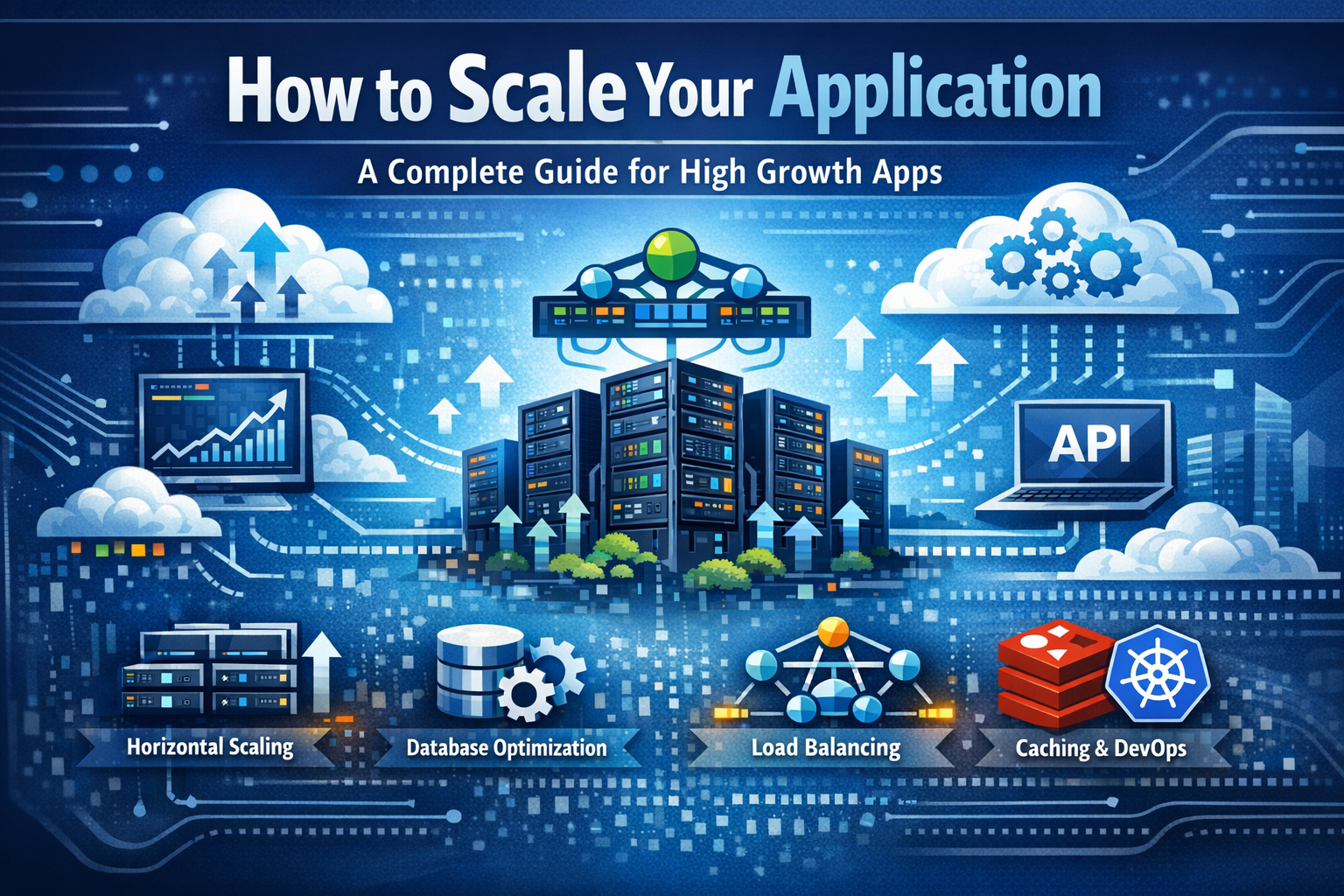
How to Scale Your Application: A Complete Guide for High Growth Apps
Table of Contents
- Introduction
- What Is Application Scalability
- Types of Scaling
- Scalable Architecture
- Database Scaling Strategies
- Caching Strategies
- Load Balancing
- Design for Failure
- Monitoring and Performance
- Frontend Optimization
- Automation and DevOps
- Security at Scale
- Advanced Scaling Concepts
- Frequently Asked Questions
Introduction
Scaling your application is essential to handle increasing traffic, users, and data without performance issues. Many startups fail when growth arrives because they ignore scalable backend architecture and performance optimization early.
This guide explains how to scale a web application using modern system design, cloud computing infrastructure, and proven backend scaling strategies.
What Is Application Scalability
Application scalability is the ability of a system to handle increasing workloads while maintaining performance, reliability, and efficiency. Scalable web applications ensure consistent performance under high traffic conditions.
Types of Scaling
Vertical Scaling
Increasing server resources such as CPU, RAM, and storage.
Horizontal Scaling
Adding multiple servers to distribute load across a distributed system.
Horizontal scaling is essential for high availability systems and large scale applications.
Build a Scalable Architecture from Day One
Monolithic Architecture
Simple and fast for MVP development but harder to scale.
Microservices Architecture
Independent services that improve scalability and fault tolerance.
Serverless Architecture
Automatically scales using cloud infrastructure.
Learn how to start correctly in our guide to building scalable MVPs.
Database Scaling Strategies
- Indexing for query optimization
- Read replicas for high traffic applications
- Sharding for large datasets
- Connection pooling for efficiency
Read detailed strategies in our backend performance optimization guide.
Caching Strategies
- Browser caching
- Server side caching using Redis
- CDN caching for global delivery
Explore more in caching strategies for high traffic websites.
Load Balancing
- Improves availability
- Prevents server overload
- Enhances performance
Learn more in load balancing guide.
Design for Failure
- Retry mechanisms
- Circuit breakers
- Auto healing systems
- Redundancy
Monitoring and Performance
- Response time tracking
- Error monitoring
- Resource usage analysis
- Database performance
Read more in application monitoring guide.
Frontend Optimization
- Lazy loading
- Optimized assets
- Reduced bundle size
- CDN usage
Improve frontend in Next.js performance optimization guide.
Automation and DevOps
- CI CD pipelines
- Docker containerization
- Kubernetes orchestration
Explore DevOps in DevOps for scalable applications.
Security at Scale
- Rate limiting
- Secure APIs
- Authentication using JWT and OAuth
- Regular updates
Advanced Scaling Concepts for Modern Applications
Modern scalable web applications rely on distributed systems and cloud computing infrastructure to handle millions of users efficiently. A strong backend architecture ensures high availability, low latency, and fault tolerance.
Containerization and orchestration enable consistent deployments and autoscaling. This improves system reliability and request throughput during peak traffic.
Edge computing and API performance optimization reduce latency and improve global performance, making them essential for high traffic web applications.
Frequently Asked Questions
How do you scale a web application?
Use horizontal scaling, caching, load balancing, and database optimization techniques.
What is the best architecture for scalable applications?
Microservices architecture is widely used for scalable systems due to flexibility and independent deployment.
What are the challenges in scaling applications?
Challenges include database bottlenecks, latency, and maintaining system reliability.
How does caching improve scalability?
Caching reduces server load and improves response time by storing frequently accessed data.
What tools are used for scaling?
Tools include Docker, Kubernetes, cloud platforms, and monitoring systems.
Final Thoughts
Scaling your application is a continuous process that requires strong system design, performance optimization, and modern infrastructure. With the right strategies, your application can handle millions of users efficiently.