
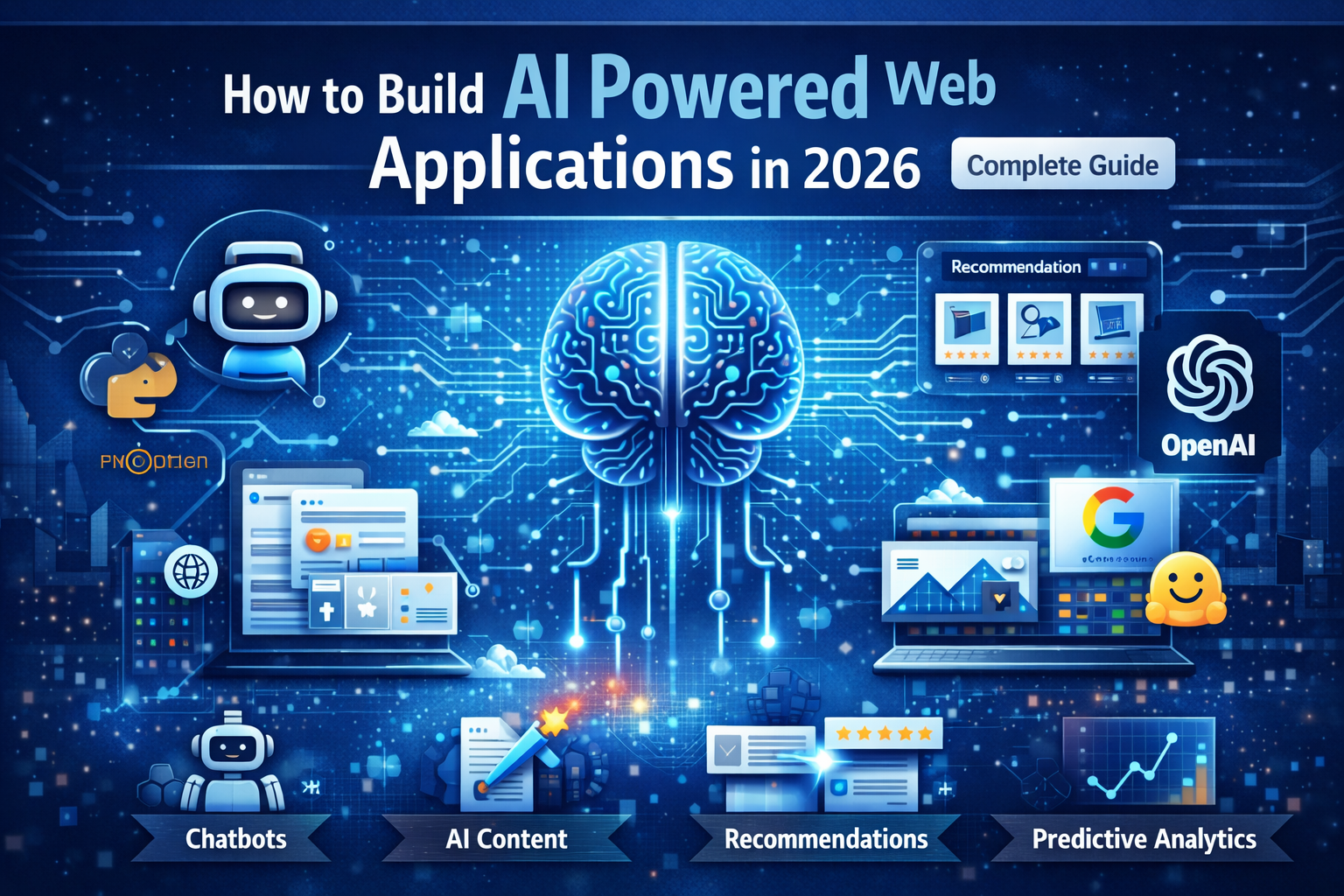
How to Build AI Powered Web Applications in 2026: Complete Guide
Table of Contents
- Introduction
- What Are AI Powered Web Applications
- Benefits of AI in Web Development
- Best Tech Stack for AI Applications
- AI Application Architecture
- How to Integrate AI APIs
- Performance Optimization
- Scaling AI Applications
- SEO for AI Driven Websites
- Future of AI Web Apps
- Frequently Asked Questions
Introduction
AI powered web applications are transforming how modern businesses operate. From chatbots to recommendation engines, artificial intelligence is now a core part of scalable digital products.
In this guide, you will learn how to build AI powered web applications using modern frameworks, scalable backend architecture, and cloud infrastructure.
What Are AI Powered Web Applications
AI powered web applications use machine learning models, natural language processing, and automation to deliver intelligent user experiences. These applications can analyze data, make predictions, and interact with users in real time.
Common examples include chatbots, AI content generators, recommendation systems, and predictive analytics dashboards.
Benefits of AI in Web Development
- Personalized user experiences
- Automation of repetitive tasks
- Improved decision making
- Higher engagement and retention
- Scalable intelligent systems
AI enhances both frontend experience and backend efficiency in modern web applications.
Best Tech Stack for AI Applications
Frontend
React, Next.js for fast and SEO optimized interfaces
Backend
Node.js, Python, or serverless functions
AI Integration
OpenAI APIs, TensorFlow, Hugging Face
Database
PostgreSQL, MongoDB, vector databases
For frontend optimization, check our Next.js performance optimization guide.
AI Application Architecture
A scalable AI system uses distributed architecture and cloud computing infrastructure.
- Frontend layer for user interaction
- Backend APIs for logic processing
- AI model layer for predictions
- Database layer for storage
Learn more about scaling systems in our complete scaling guide.
How to Integrate AI APIs
- Choose the right AI provider
- Secure API keys and endpoints
- Optimize API calls for latency
- Handle rate limits and errors
Efficient API performance is critical for AI driven applications.
Performance Optimization
- Reduce API response time
- Use caching for AI responses
- Optimize database queries
- Implement lazy loading
Read more in our backend performance optimization guide.
Scaling AI Applications
AI applications require scalable backend infrastructure due to high computation needs.
- Use autoscaling cloud services
- Implement load balancing
- Optimize model inference
- Use distributed systems
Explore scaling strategies in our guide to handling millions of users.
SEO for AI Driven Websites
AI websites must be optimized for search engines to rank effectively.
- Fast loading speed
- Structured data markup
- Keyword optimized content
- Internal linking strategy
SEO combined with AI creates powerful growth opportunities.
Future of AI Web Applications
The future of web development is driven by artificial intelligence, automation, and real time data processing.
Technologies like edge computing, vector search, and large language models will redefine how applications are built and scaled.
Frequently Asked Questions
What are AI powered web applications?
AI powered web applications use machine learning and automation to provide intelligent features like chatbots and recommendations.
What is the best tech stack for AI apps?
A combination of Next.js, Node.js, Python, and AI APIs is commonly used.
How do you scale AI applications?
Scaling is achieved using cloud infrastructure, distributed systems, and optimized APIs.
Is AI good for SEO?
AI can improve SEO through content generation, personalization, and better user experience.
What are examples of AI web apps?
Examples include chatbots, recommendation engines, and AI content tools.
Final Thoughts
Building AI powered web applications requires a combination of scalable architecture, performance optimization, and modern AI tools. With the right approach, you can create intelligent applications that deliver exceptional user experiences and scale efficiently.